
Dublin Analytical Education
Supercritical CO₂: The Next Generation Sterilant
In Summary
Supercritical CO₂ is emerging as an alternative sterilisation method for heat sensitive materials. It offers low temperature microbial inactivation without leaving harmful residues.
Supercritical CO₂: The Next Generation Sterilant
Sterilisation is a critical procedure designed to eliminate all viable microorganisms—including bacteria, viruses, fungi, and spores—from surfaces, instruments, and fluids to ensure safety in medical and laboratory environments. It plays a vital role in infection control by preventing the transmission of harmful biological agents that could compromise patient health.
Medical devices and surgical instruments that come into direct contact with sterile tissues or mucous membranes carry a significant risk of introducing pathogens into the body. Without effective sterilisation, these contaminants could lead to infections, complications, and even life-threatening conditions. This underscores the necessity of reliable sterilisation methods in healthcare and related industries.
Conventional Sterilisation and Sterility Assurance Level (SAL)
Before evaluating CO₂ as a sterilant, it is crucial to examine conventional sterilisation methods such as steam sterilisation, gamma irradiation, and ethylene oxide (EtO) sterilisation. Each of these methods has inherent limitations. Steam sterilisation is widely used and cost-effective but is unsuitable for heat-sensitive materials and may compromise the biocompatibility of metallic devices. Gamma irradiation works well on heat-sensitive materials but can degrade polymer durability and generate potentially harmful radiotoxins. EtO sterilisation is commonly employed for temperature-sensitive materials, though it poses toxicity and carcinogenic risks, and requires lengthy aeration to remove residual gas. These drawbacks highlight the need for alternative methods.
Assessing the effectiveness of any sterilisation method requires an understanding of the Sterility Assurance Level (SAL). The SAL quantifies the probability of a viable microorganism surviving on a material post-sterilisation. For example, a 99% microbial reduction corresponds to a 2-log reduction. In medical settings, the standard requirement is an SAL of 10⁻⁶ (SAL-6), meaning there is only a one-in-a-million chance that a single viable microorganism remains. This stringent standard is crucial for ensuring the safety of implants and surgical instruments in direct contact with sterile tissues, helping minimise the risk of infection and related complications.
Supercritical CO2 as an Alternative Sterilisation Method
Supercritical carbon dioxide (scCO₂) sterilisation has emerged as a promising alternative due to its unique advantages. Unlike ethylene oxide (EtO), scCO₂ is non-toxic, non-flammable, and does not leave harmful residues. It is highly compatible with polymers, thus avoiding the degradation often caused by gamma irradiation. With a critical temperature of 31°C, scCO₂ sterilisation is suitable for heat-sensitive materials, helping preserve their structural integrity.
Its low viscosity and zero surface tension enable rapid penetration into complex structures, enhancing sterilisation efficiency. As an abundant and cost-effective resource, CO₂ also offers an economically viable and sustainable sterilisation method. These benefits make scCO₂ a compelling alternative to traditional techniques.
Mechanisms of CO₂ Sterilisation
The exact mechanism behind microbial deactivation by supercritical CO₂ (scCO₂) is still debated, but evidence points to a combination of multiple factors. One crucial aspect is the penetration of CO₂ through the microbial cell envelope, accompanied by the extraction of cellular components. Acidification occurs as CO₂ reacts with intracellular water to form carbonic acid, lowering pH and disrupting key metabolic processes. This pH reduction significantly weakens microbial resilience, particularly in spores, and amplifies the impact of high-pressure CO₂.
Additionally, scCO₂ permeates cell membranes, compromising their structural integrity and increasing permeability. Rapid decompression can then lead to cell rupture. The disruption of membranes further facilitates the extraction of essential intracellular components, contributing to effective microbial inactivation. Together, these mechanisms underscore the potential of scCO₂ as a robust sterilisation method capable of targeting microorganisms through multiple pathways.
Supercritical CO₂: The Future of Safe and Effective Sterilisation
Supercritical CO₂ (scCO₂) stands out as a non-toxic, low-temperature, and material-friendly approach to sterilisation. Unlike methods that rely on high heat, radiation, or chemical residues, scCO₂ can penetrate complex structures, disrupt microbial membranes, and extract vital cellular components without damaging sensitive materials. Its rapid processing time, broad material compatibility, and environmentally friendly profile position it as a promising solution for medical device sterilisation.
By offering an economically viable and sustainable alternative, scCO₂ may well represent the next generation of safe and effective sterilisation, paving the way for improved infection control and patient safety in healthcare and related industries
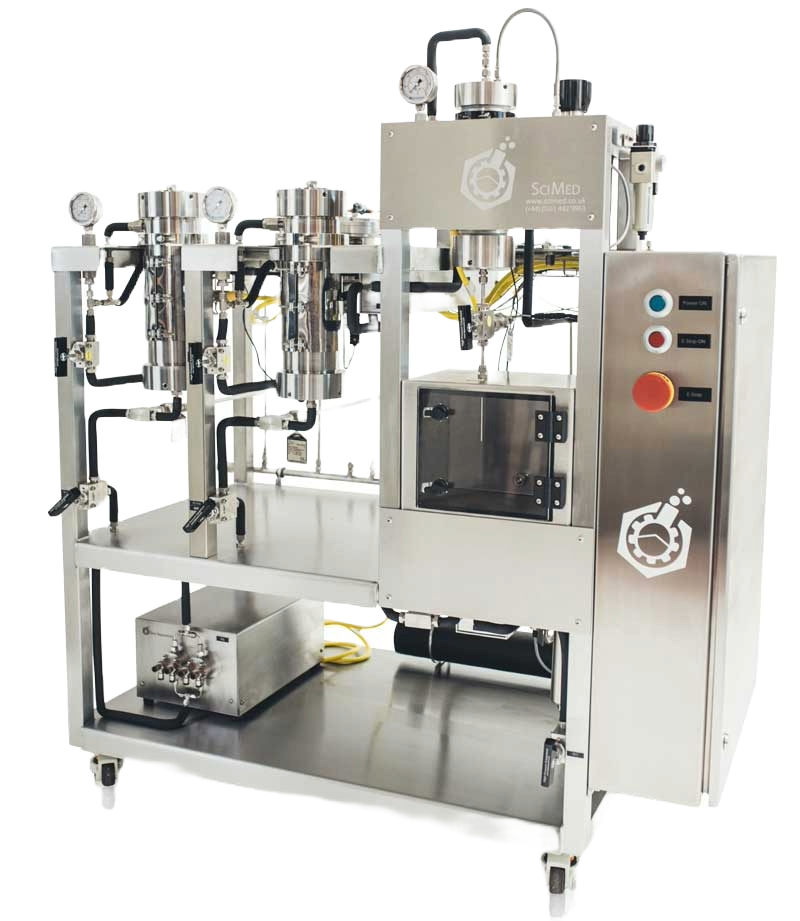
Advanced CO2 Reaction Systems
Advanced CO2 Reaction Systems offer innovative solutions for supercritical CO2 reactions and solventless transformations, ensuring efficient transformations.
What to do next?
If you require more information about supercritical CO₂ sterilisation—such as detailed protocols, application guidance, or a conversation with a member of our team—please contact us using the methods provided below. We’re here to help you explore this innovative sterilisation technology and ensure it meets your specific requirements.
Page FAQ's
It provides effective microbial reduction without high heat.
Medical devices, pharmaceuticals and sensitive polymers.
Yes. Solutions for R&D and process development.
Contact Us Today
We take great pleasure in assisting you and ensuring you get a prompt response to your questions
Live chat opening hours Mon – Fri 9:15 to 16:30 (UK Time)