
Dublin Analytical Education
In‑Situ, In‑Line and Advanced DLS Measurement Techniques
In Summary
Interchangeable measurement heads extend DLS beyond cuvettes. In‑situ probes, flow‑through modules and multi‑angle goniometers allow real‑time particle sizing in reactors, pipelines and complex environments.
What is in‑situ DLS and why use it?
Traditional bench‑top DLS requires transferring a sample into a cuvette, which is impractical for sealed reactors or hazardous environments. An in‑situ head delivers the laser to the sample via optical fibres and collects back‑scattered light through the same probe. This allows direct measurement inside reactors, vials or process vessels without sampling.
The passive design withstands high pressure and ATEX environments, enabling real‑time monitoring of polymerisation, crystallisation and other reactions.
How does the milli‑fluidic head enable in‑line DLS measurements?
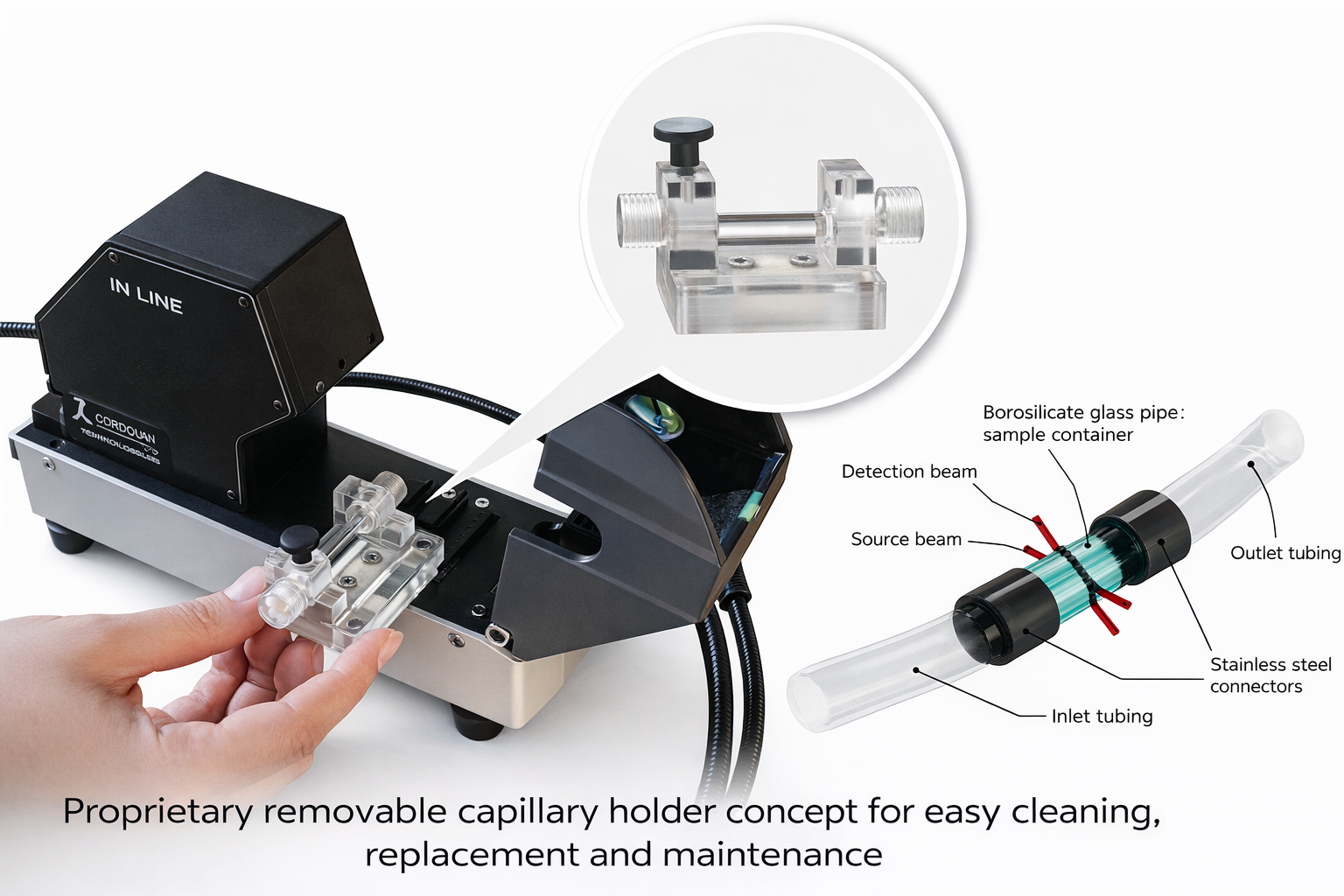
For continuous nanoparticle synthesis and separation processes, the milli‑fluidic head integrates a small flow channel with a DLS detector. As fluid passes through the capillary, the module measures particle size at a fixed scattering angle (typically 130°) without stopping the flow.
Interchangeable capillaries support a range of flow rates and particle sizes, making this head ideal for SEC‑HPLC, nanoprecipitation and in‑line crystallisation monitoring.
CLICK TO VIEW
Why choose the Dual Thickness Controller (DTC) head?
Concentrated or absorbing suspensions often require dilution to minimise multiple scattering. The DTC head employs a dual‑path design that extends the measurable concentration range by roughly one order of magnitude. It enables accurate measurements of high‑viscosity or absorbing samples without diluting or altering their properties.
What does the compact goniometer head allow you to do?
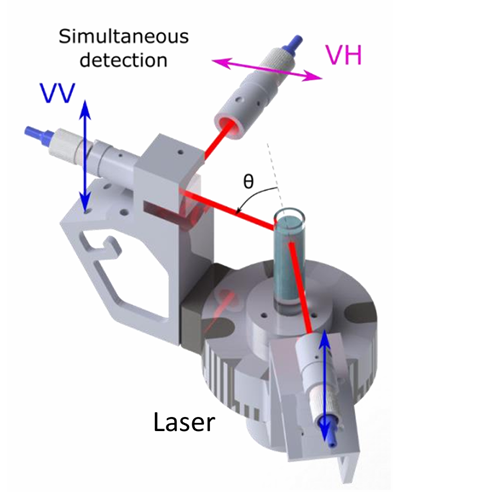
Multi‑angle DLS provides structural information beyond hydrodynamic size. The compact goniometer head is an ultra‑compact module that continuously scans scattering angles from 20° to 150°, enabling simultaneous DLS and static light scattering (SLS).
It can determine molecular weight, radius of gyration and aggregation behaviour. Because alignment is built‑in, it simplifies complex multi‑angle experiments.
What to do Next?
To integrate real‑time DLS into your process or experiment, speak with our experts about the VASCO Kin analyser and its interchangeable heads. We can help tailor a contactless, in‑line or multi‑angle DLS solution for your application. Contact Dublin Analytical for a customised consultation.
Page FAQ's
- In-situ DLS measures particle size directly inside reactors or sealed systems without removing the sample.
- It allows measurement of concentrated or absorbing samples without dilution.
- It provides additional structural information such as molecular weight and aggregation behaviour.
Contact Us Today
We take great pleasure in assisting you and ensuring you get a prompt response to your questions
Live chat opening hours Mon – Fri 9:15 to 16:30 (UK Time)