
Dublin Analytical Education
DLS for Real‑Time Process Monitoring and Advanced Integration
Summary
DLS can be integrated into reactors, microfluidic chips and automation platforms to provide continuous, real‑time particle size information. Specialised probes and accessories enable measurements in sealed containers, ATEX environments and high‑throughput formats.
How does inline Dynamic Light Scattering improve real time particle analysis?
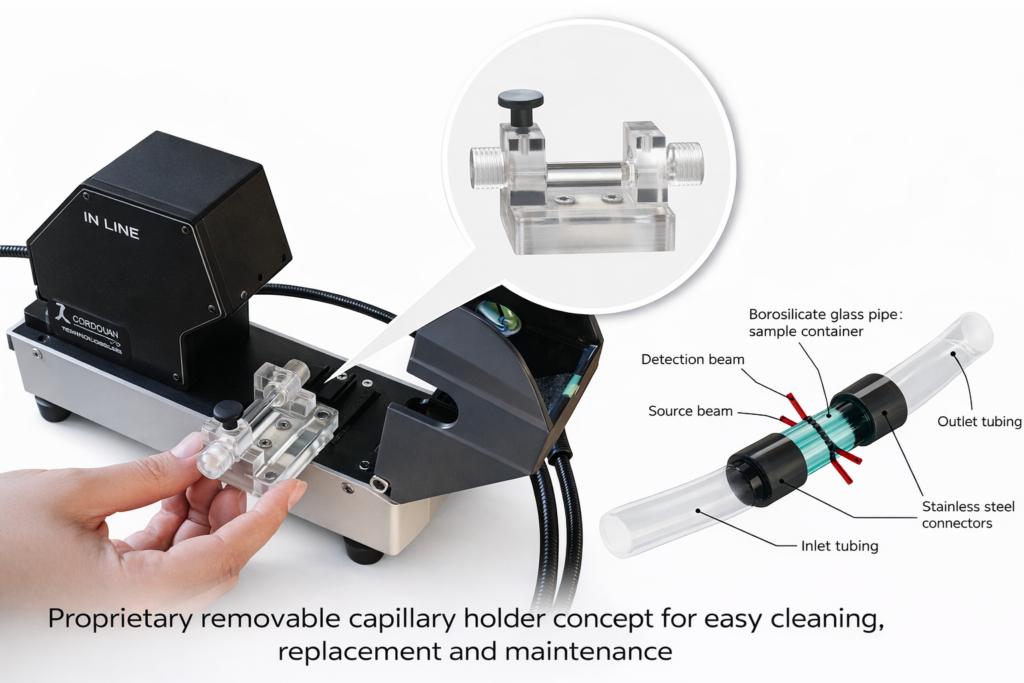
In traditional particle analysis, sample extraction and offline measurements are common but can introduce variables that alter particle behaviour. The VASCO KIN overcomes these limitations by using Dynamic Light Scattering (DLS) with a remote optical head, allowing direct, inline measurement that preserves the natural state of the sample.
The VASCO KIN’s advanced DLS system enables precise, time-resolved particle analysis, providing valuable insights into both particle size and aggregation kinetics. This capability is especially useful for labs focused on nanoparticle synthesis, where understanding particle growth and stability during formation is crucial. The system’s real-time dynamic light scattering technology allows researchers to monitor particle size changes and kinetics as they occur, delivering reliable data that supports the development and refinement of nanoparticle formulations. The contactless design further supports the integrity of sensitive samples, making it suitable for suspension stability testing and aggregation kinetics analysis without interference.
VASCO KIN Particle Size Analyzer Product Video
How can DLS be integrated into reactors and microfluidic chips?
The in‑situ head allows DLS measurements through reactor walls or sealed vials without sampling. For microfluidic applications, custom probes and milli‑fluidic heads perform measurements in channels as small as 100 µm. These setups enable real‑time monitoring of nanoprecipitation, polymerisation or crystallisation processes.
Can DLS be coupled to lab automation and high‑throughput systems?
DLS modules integrate seamlessly with syringe pumps, optical microscopes, multi‑well plates and lab automation platforms. Automated systems can measure samples sequentially or simultaneously, enabling high‑throughput screening of formulations, process conditions or reaction parameters.
What measurement environments are possible?
With appropriate probes, DLS can be performed in sealed containers, Eppendorf tubes, autoclaves and ATEX environments. Stirring generally disrupts measurements, but the VASCO Kin can acquire data during short pauses in stirring. DLS can also determine particle concentration via calibration, perform measurements in multi‑well plates and couple directly to HPLC SEC systems for in‑line analysis.
What are the benefits of real‑time DLS monitoring?
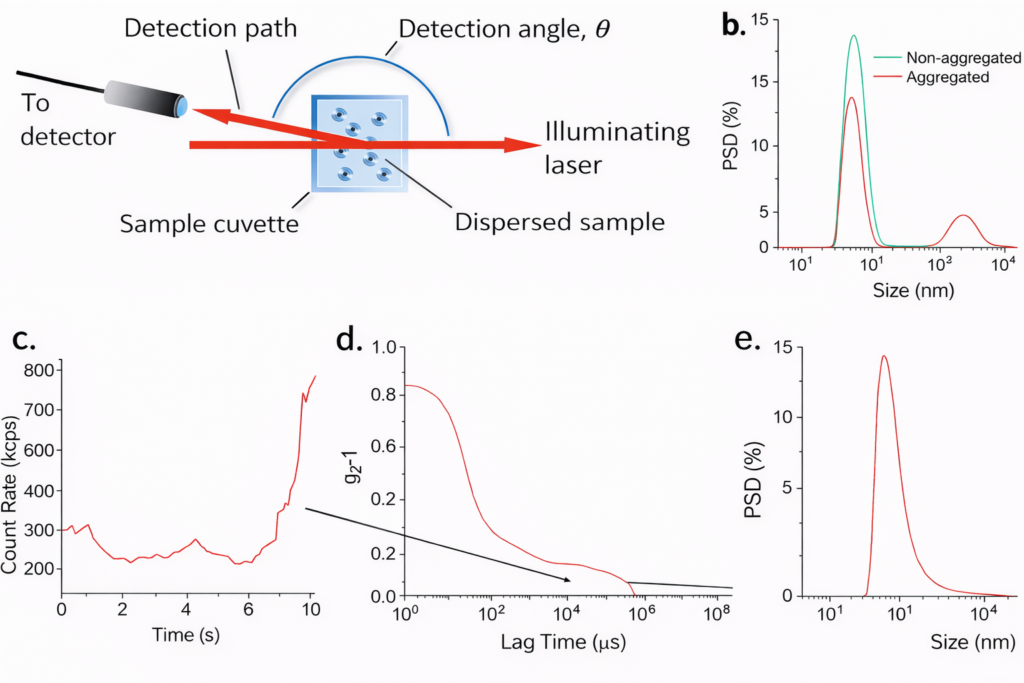
Real‑time DLS provides immediate feedback on particle size during synthesis or formulation, enabling rapid optimisation and process control. It eliminates the need for offline sampling and reduces waste by catching deviations early. Coupling DLS with microfluidics or process reactors facilitates automated reaction monitoring and closed‑loop control.
What to do next?
If you need to monitor particle size in real time, integrate DLS into microfluidics or automated platforms, or measure within sealed and hazardous environments, our team can help. The VASCO Kin analyser offers versatile probes and software for in‑situ, in‑line and high‑throughput applications. Contact Dublin Analytical to discuss integrating DLS into your process and automation workflows.
Page FAQ's
- DLS can measure liposomes, nanoparticles, polymers, micelles and proteins.
- Yes, it is highly sensitive to aggregates due to their strong light scattering.
- Yes, including proteins and exosomes, provided samples are prepared correctly.
- DLS measures average size, while NTA tracks individual particles.
Contact Us Today
We take great pleasure in assisting you and ensuring you get a prompt response to your questions
Live chat opening hours Mon – Fri 9:15 to 16:30 (UK Time)