Dublin Analytical Education
One lamp to rule them all! What is continuum source atomic absorption spectrometry?
One Lamp to rule them all?
One lamp for lithium
One lamp for sodium & potassium
One lamp for most of the periodic table
One lamp for fluorine and sulphur as molecules
One lamp to measure multiple elements really quickly
One lamp to rule them all!
In the land of Analytik Jena*
*with sincere apologies to J.R.R. Tolkien!
In Summary
Continuum source AAS uses a single high intensity light source to measure multiple elements. It offers improved flexibility compared to traditional hollow cathode lamp AAS.
But seriously, what is continuum source (CS-) AAS?
Atomic adsorption spectrometry (AAS) is a commonly used method for measuring elements in samples from many industries and for research purposes. It may be used in flame, graphite furnace, or hydride configurations. AAS uses a light source to measure the absorption of light at a specific wavelength.
The light source is typically a hollow cathode lamp, but they are only able to measure one element; you need a different lamp for every element you want to measure. This can be called line source (LS)-AAS. Modern instruments have a carousel where you can load up to 8 lamps, but switching between lamps is slow, so you can only measure one element at a time.
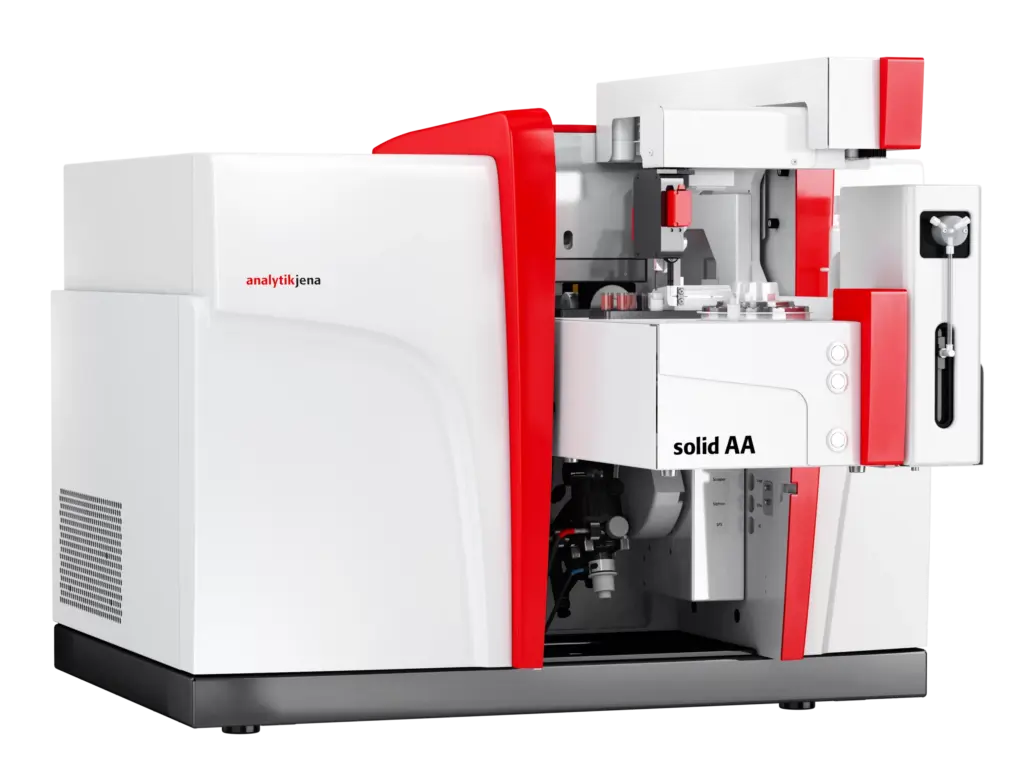
One unique instrument, the ContrAA 800 from Analytik Jena, uses a single lamp for all elements and wavelengths, a continuum source Xenon lamp.
It’s called continuum source atomic adsorption spectrometry (CS-AAS)
That sounds good, but why is CS-AAS better?
- You can measure any element you want without having to buy and store a lot of single lamps
- You can perform fast sequential multielement analysis, saving a lot of time
- The light from the Xenon lamp is more intense meaning that limits of detection are lower
- You can measure high concentrations by measuring on the side of the peak, and this can be applied post-analysis in data processing (saving a dilution step)
- You can measure any wavelength, including molecular wavelengths allowing measurement of Fluorine (as Sr-F for example, just add Sr) and sulphur
- Background and interference corrections are simplified and better
- You can use an internal standard element
Okay I want to know more about CS-AAS – but I am guessing its expensive?
The ContrAA 800 has a higher purchase price than traditional hollow cathode lamp systems, but provide much more capability. If you have a need for multiple elements it is far quicker, using less fuel, and there is no need to purchase and store multiple lamps. You can even use an internal standard element to correct for matrix effects.
The capability of CS-AAS is more comparable to ICP-OES, offering similar limits of detection (better for graphite furnace), a similar working range, and fast multielement measurements. As the below breakdown shows*, the running costs for CS-AAS are nearly x20 lower than those for ICP-OES, as it uses acetylene as a fuel rather than argon gas.
You can download our SOPs for Parr Calorimeters here
Parr 1341
Parr 6100
Parr 6200
Parr 6400
ContrAA 800 Flame:
- Gas consumption = 15 to 20 L/min of Argon = ~1020 L/hr
- Typical ICP Running Time per sample = ~300 sec
- = 12 samples per hour costing £0.7 in gas consumption
- = £0.06 gas consumed per sample (10,000 samples = ~£600)
Standard ICP OES & MS Systems:
- Gas consumption = 15 to 20 L/min of Argon = ~1020 L/hr
- Typical ICP Running Time per sample = ~300 sec
- = 12 samples per hour costing £15 in gas consumption
- = £1.25 gas consumed per sample (10,000 samples = ~£12,500)
Potential Saving on gas running costs based on the analysis of ~10,000 samples per year = £125,00 (ICP) – £600 (ContrAA) = £11,900 per year.
10-years saving = £119,000
What to Do Next?
Speak to us to explore whether CS-AAS is the right fit for your laboratory, and discover how it can reduce consumable costs, speed up analysis, and expand your elemental testing capability. Plus, view more of our education pages down below!
Page FAQ's
It uses one lamp for all elements, improving efficiency and reducing setup time.
Labs performing multi element analysis without switching lamps for each test.
Yes. Instruments designed for routine and advanced elemental analysis.
Contact Us Today
We take great pleasure in assisting you and ensuring you get a prompt response to your questions
Live chat opening hours Mon – Fri 9:15 to 16:30 (UK Time)