
Dublin Analytical Applications
What is Rheology?
In Summary
Rheology is the study of how materials flow and deform under applied force. It explains not only how ‘thick’ or ‘thin’ something appears, but also flow characteristics, structure recovery and time/temperature dependence. While viscosity describes resistance to flow, rheology covers a wider set of behaviours like elasticity, yield stress, thixotropy and viscoelasticity.
Rheology matters to scientists, engineers and quality teams because it links formulation and structure to performance. It helps predict how a product will pump, spread, level, cure or remain stable in storage. In the UK and Ireland, rheology underpins product quality in pharmaceuticals, personal care, food and drink, polymers, inks and coatings, construction materials and energy.
How does rheology work?
Rheology quantifies how materials respond to force by controlling and measuring stress and strain. In a rotational test, the instrument applies a known motion and records the resisting torque to produce a flow curve of shear stress versus shear rate. This reveals whether a material is Newtonian or non-Newtonian and whether its viscosity changes with shear rate.
In oscillatory tests, the instrument gently deforms the sample back and forth and measures how much energy is stored versus dissipated. From this you obtain elastic and viscous moduli (G’ and G’’) that describe structure and stability. Modern rheometers use cone-plate, parallel-plate or coaxial cylinder geometries to suit different viscosities, particle sizes and sample volumes. Precise temperature control is used to match process conditions and improve repeatability.
By combining steady shear and oscillatory methods, you can simulate real situations like pumping, coating, spreading, mixing and setting. This turns rheology into a practical tool that links lab data to production performance.
Intuitive Handling
Touchscreen Operation
Versatile Applications
Paints & Inks, Cosmetics & Pharmaceuticals, Polymers, Mining & Construction, Education, Batteries
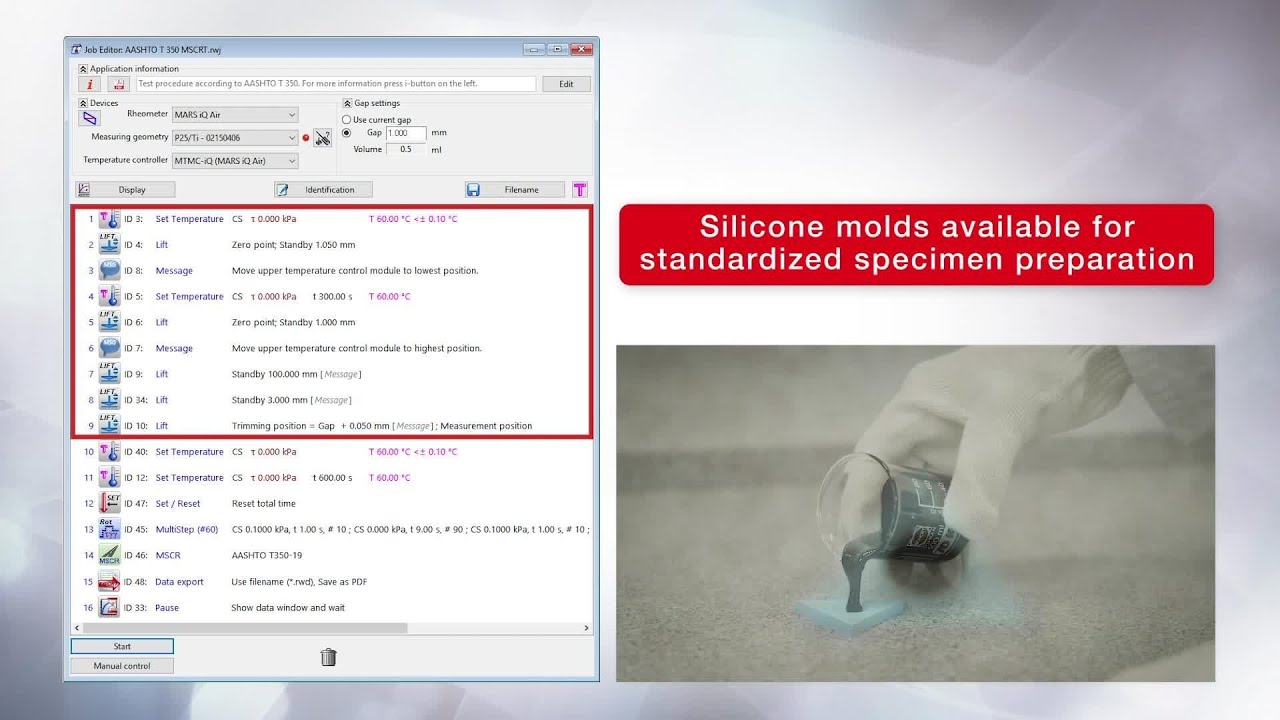
Comprehensive Software
HAAKE RheoWin
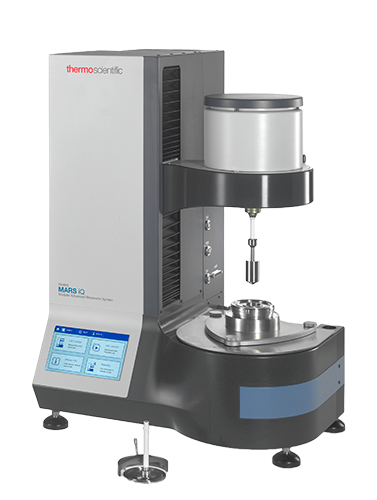
Thermo HAAKE MARS iQ
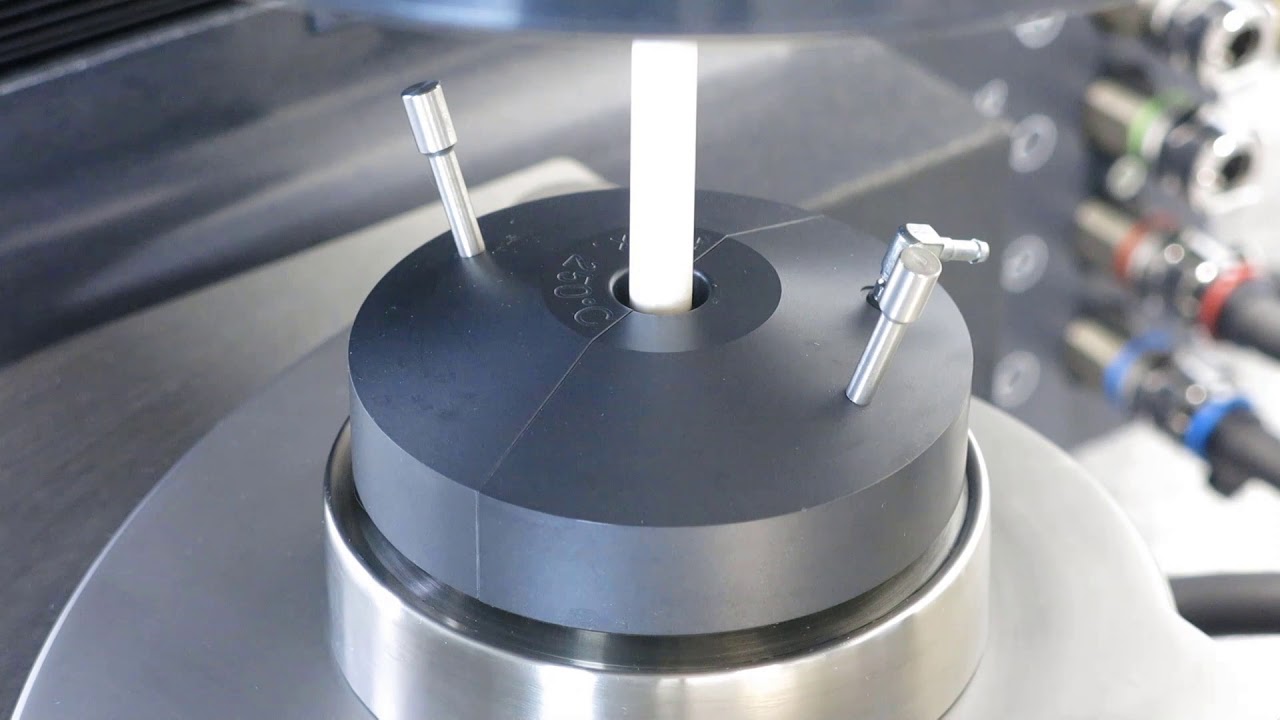
The HAAKE MARS iQ Rotational Rheometer is a state-of-the-art device designed for intuitive and reliable rheological measurements. Available with either a ball bearing or air bearing configuration, it can be used with a wide range of accessories and temperature control modules.
Ideal for characterising a variety of materials, including liquids, slurries, polymers, and more, it offers fast, reliable results in both research and quality control environments.
Thermo HAAKE MARS iQ Rheometers Product Video
Playlist
4:00
2:28
4:13
Applications of rheology
Pharmaceuticals and biotech. Creams, gels and suspensions. Can demonstrate how the material will behave if syringed, spread, and long-term physical stability
Cosmetics and personal care. Lotions, shampoos and sunscreens. Align sensory feel with shelf life and packaging.
Food and drink. Sauces, dairy, syrups and batters. Set mouthfeel, pumpability and consistency.
Polymers, inks and coatings. Dispersions, resins and adhesives. Optimise shear thinning, levelling, sag and cure windows.
Construction and infrastructure. Cement pastes, bitumen, asphalt binders, sealants and grouts. Predict workability and compliance.
Energy and lubricants. Oils, greases and drilling fluids. Characterise temperature behaviour, yield stress and film formation.
UK and Ireland context: Many local manufacturers and research groups use rheology to characterise their products, reduce material usage and improve process efficiency in sustainable operations.
What to Do Next?
If you want to understand which rheology tools, methods or geometries are best for your materials, the next step is to speak with a Dublin Analytical specialist who can provide tailored recommendations, arrange demonstrations, share method templates and guide you towards the right setup for your development or QC needs.
Page FAQ's
No. Rheology also covers soft solids and semi-solids such as gels, creams, pastes and melts. These materials often show viscoelastic behaviour, yield stress and time dependence that need oscillatory tests as well as steady shear.
Viscoelastic materials exhibit both viscous and elastic behaviour when deformed. Under small deformations they store some energy and dissipate some. Measuring storage and loss moduli helps you understand whether your sample is behaving more like a liquid or a solid under an applied stress.
Shear thinning means viscosity drops as shear rate increases. Many products are thick at rest yet flow easily during pumping or spreading. This improves processing and user experience while helping to prevent sag or drip at rest.
Cone-plate and parallel-plate are versatile for many samples. Coaxial cylinders are well suited to lower viscosities and continuous flow. Selection depends on sample type, particle size, target shear range and temperature. SciMed’s team of in-house rheologist can advise based on your applications.
Benchtop rheometers typically require small volumes, often less than a millilitre for cone-plate. Parallel-plate and cylinders may require more. We can recommend a setup that balances sensitivity with realistic sample usage.
Very. Small temperature changes can have a dramatic impact on the viscosity of a material. Using a Peltier temperature module is the best way to accurately match process conditions and improve repeatability.
Contact Us Today
We take great pleasure in assisting you and ensuring you get a prompt response to your questions
Live chat opening hours Mon – Fri 9:15 to 16:30 (UK Time)